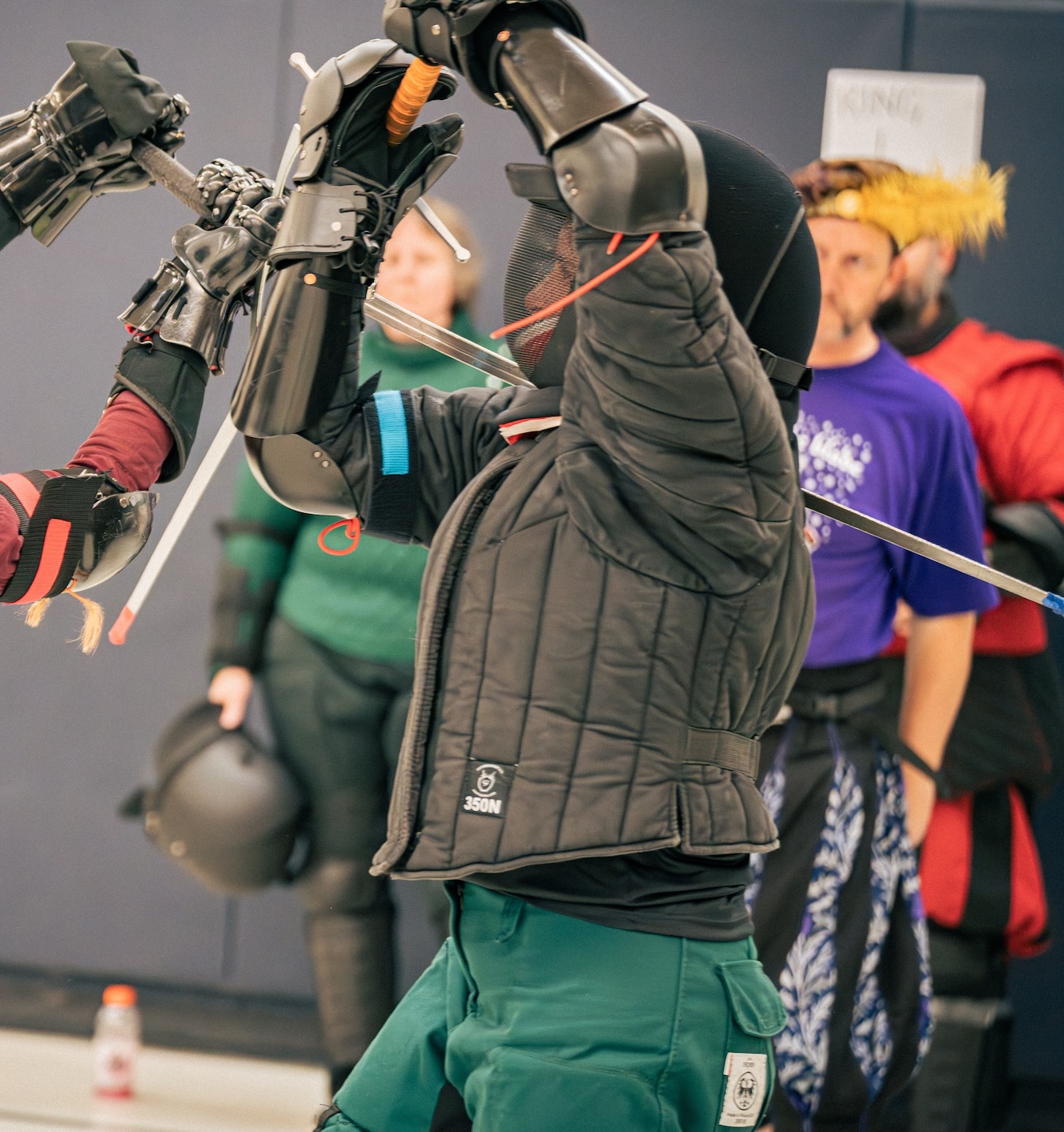
Longsword Characteristics#
The meta in Southern Ontario tends towards quick and agile feders (more on what a “feder” is in a moment). Longswords come in a wide variety of weights and sizes, in most cases this will directly affect their performance, with the notable exception of Esker Forge longswords. Even then, there is no one sword that is clearly better or worse than all the others. Your fencing style, size, and athleticism will ultimately determine the best longsword for you.
What this all means for you:
Tournament Specifications#
Unlike sabres, which have weight minimums, longswords have weight maximums. If you plan to attend tournaments, your absolute upper limit is 1800g, and the blade length should be no more than 102cm.
Tournament rules change farther afield. For example: Montreal Sword Meisters set the maximum weight at 1700g, and the Maritime Sword School at 1650g. These are still hefty swords that make force control difficult, so something lighter is strongly recommended for beginners.
If you don’t plan on attending a tournament, then good news: you get to pick whatever longsword works best for you.
Length#
Blade lengths can be as short as 87cm (approx 34") or as long as 104cm (approx 41"). Anything shorter than 95cm will put you at a disadvantage, and anything longer than 101cm will make certain techniques harder. A longer blade is great when you and your opponent decide to thrust at the same time, but longer blades also need more room to disengage, giving your opponent better winding and binding opportunities.
Don’t agonize too much over the exact length. Try some longswords, see what works for you, and then go buy a longsword of a similar length, give or take a few cm.
Weight#
Even a heavy longsword can move pretty fast on a first intention. Lighter longswords can change directions faster which can be useful after initial contact. Heavy longswords on the other hand tend to be associated with stronger binds, owing to there being more material in the blade. Esker Forge would disagree because their swords bind through carefully tuned physics rather than mass alone, but their swords are (so far) exceptional.
Our club considers “light” longswords to be in the 1250-1400g range. These are fun and you can get in a lot of reps. When striking into opposition, a lighter longsword will usually have less presence than a heavier one.
Our club considers “medium” longswords to be in the 1400-1550g range. These have presence without being overly unkind to your opponent. A lot of popular longswords fall into this range.
Our club considers “heavy” longswords to be anything over 1550g. The added mass helps with parrying and works well with blade actions, but these swords can also be tiring to use without conditioning, and missing a strike can leave you wide open. Control becomes especially important with heavier longswords so as to avoid injuring your sparring partner.
An important consideration is that not all swords weigh their advertised weight. There are a lot of manual processes that go into their creation which can result in discrepancies. If you’re ordering from a distributor, you can ask them to weigh a sword before you buy it. If you’re ordering from an OEM, you can try to ask for more information, or in some cases request a specific weight.
Crossguard Styles#
Though nominally for defence, a crossguard is also a great way to make your sword uniquely stand out. It’s therefore important to understand how this affects safety.
Squared and bulbed ends are safest. Curved/upswept quillons might look like they would catch an opposing sword better, but in practice make little difference. Curved/upswept quillons can also be unsafe for your sparring partner. Some crossguards include hand protection rings which may seem useful, but as a beginner, err on getting your first longsword without them. We have no self-control and rarely stop at one sword, so if you really want crossguard rings, you can always get them on your next sword.
Overall: choose crossguard styles that have blunt or rounded faces, and which do not otherwise change the overall geometry of the longsword.
Pommels#
The placement of your offhand on the pommel lets you use a longsword like a lever instead of a hammer. An OEM that lets you customize the pommel is letting you pick something that will change the sword’s feel and also look pretty neat when hanging on your wall.
Pear pommels get the job done, but depending on size and gloves, may sometimes let your hands slip. Onion, mushroom, and faceted pommels share the basic idea behind a pear pommel but are easier to grip.
Disc pommels are another option, they help with edge alignment since discs have distinct faces. Alignment arguably comes with time and practice rather than pommel shape, but swords are deeply personal so if you have the chance to try one, see if it speaks to you.
Note any weight differences when choosing a pommel, as these will moderately shift the sword’s weight. “Moderately” is the operative word though, unless you are choosing a truly massive pommel.
Blade Types#
There are, broadly speaking, two types of blades: longsword blades, and feder blades.
Longsword blades look like the real thing: they begin wide at the hilt, and taper as they reach the point. This puts a lot of the sword’s mass in front of the hilt, giving it more forward weight and delivering more force with strikes.
Feder blades (short for “federschwert” or “feather sword”) often have a few inches near the hilt where their width is slightly wider than that of a normal longsword, called a “schilt.” The blade will then thin considerably for the rest of the sword’s length. The lighter blade is kinder to opponents and transfers some of the weight backwards.
Feder blades are a better option for training most of the time, being more forgiving to both you and your opponent. There are reasons to get a longsword blade, but if you’re unsure, a feder is the recommended default option. Remember: it’s your first sword, not your only sword!