Swords Overview#
Whether you’ve deliberated carefully, or are being driven by the reckless but reasonable desire to have a sword right away, it’s time to get one.
Steel HEMA trainers are not like regular swords. Despite being swords there is a lot of work that goes into making them safer than just taking a real sword and blunting all the edges. Good HEMA trainers also have high surface area tips and flex under thrust. For this reason you should never use a real blunted sword in partner drills or sparring, and especially never a sharp one.
Producing a trainer that flexes under thrust but maintains its shape in a bind can be challenging, and you will sometimes see complaints of swords being too “floppy.” It turns out we’re just as good at making floppy swords as we are at making stiff ones – the trick is to make one that can do both under the right circumstances. Esker Forge has a pretty good write-up about this which is not required reading, but might be fun if that’s your kind of jam.
All this to say: when you begin looking at swords and hearing critiques of them, you’ll have to decide what matters most to you. Many things in life are a trade-off, even swords! It will be this way at least until material sciences produces the perfect HEMA trainer, maybe even after that too.
Balance#
Is the sword forward weighted, or back weighted? The balance can make a heavy sword feel more nimble, or a light sword feel like it wants to fall into a cut. OEMs will list this specification as its “point of balance,” which is the point on the blade measured from the guard where the sword can balance itself if placed on your finger.
A forward weighted sword will have more momentum in a cut. Sabres will moulinet well through a cut into a guard, and longswords will strike well in opposition. A forward weighted sword will have more presence than a backweighted sword of the same weight.
A backweighted sword will feel more nimble, and will depend on you to make effective cuts and thrusts. A backweighted sword will have less presence than a forward weighted sword of the same weight.
Tips#
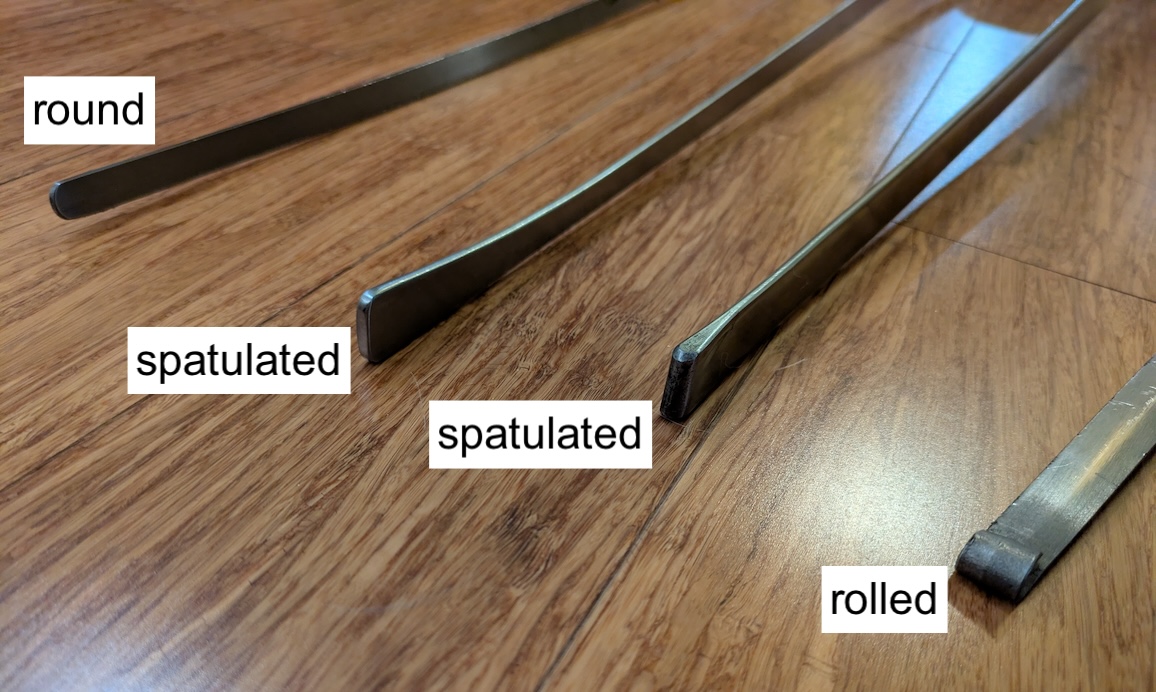
You’ll find three kinds of tips on steel trainers:
Round tips are to be avoided whenever possible. Rounded tips offer very little surface area, making them a puncture risk even if they seem blunt. Round tips will wear down leather tip covers quickly, so a thermoplastic cover is practically required. Always opt for a rolled or spatulated tip instead, and be deeply suspicious of swordmakers that do not offer these options.
Rolled tips offer the most surface area and therefore the most safety while intact. With a rolled tip, the end of the blade has been folded in on itself to make a big round loop. Rolled tips may be slightly weaker and more prone to breaking, which is why a brightly-coloured tip cover is important to draw attention to a broken blade. That’s not to say they are fragile – they can and do last a long time.
Spatulated tips are like a reverse sword tip. Instead of the blade focusing into a thin pinpoint, it flares outwards for the last 1-2cm to create a larger surface area. Spatulated tips can offer good protection if the blade has a large profile to begin with, but even a spatulated tip does not guarantee safety, and still must have a tip cover. In a high-profile tournament incident, a spatulated rapier punctured a jacket because, as one fencer observed, a spatulated tip that small was functionally “unrecognizable from a leather punch.” Regardless, spatulated tips provide an excellent surface to attach a leather or thermoplastic tip cover.
Customization#
Because many swords are made-to-order, you can sometimes request customizations. Some of these are offered formally as part of the ordering process like engravings or wrap materials and colours, and some you may have to ask about proactively. Some shops will allow you to request changes to the weight or blade length for an additional charge, though some swordmakers do not warranty such work.
“Unlisted" customizations are not always available, though as long as you’re polite, it doesn’t hurt to ask. If you’re not polite, bear in mind that these are small businesses and you may be talking to the person who will be making your sword, possibly even the owner. Sword makers have plenty enough demand to ignore your order if they decide it’s not worth the hassle.